
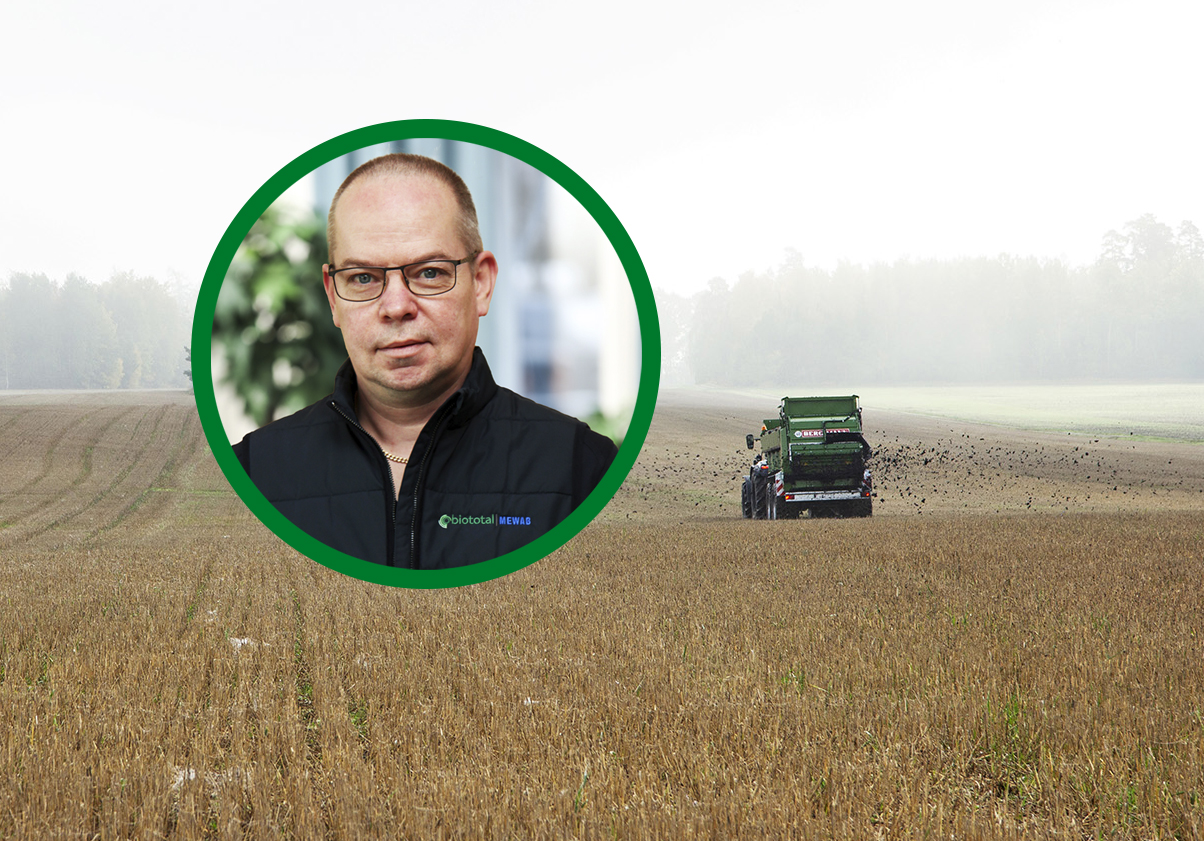
The weather during planting and harvest has been good, and farmers are satisfied, but they feel that grain prices are too low. Ferdinand Eskilsson, account manager in Östergötland, explains that we have applied more sludge and biofertilizer this season than last, and that more and more farmers are taking notice of our renewable fertilizers.
In October, we spread the last of the sludge on farmland in Östergötland. Ferdinand Eskilson, account manager at Biototal, is now working on compiling spreading records and planning for next season. He sums up this year’s season as a success.
– Overall, both the summer and fall have gone very smoothly with good weather, except for October, but that’s nothing unusual. The season started a week late, but farmers are generally satisfied.”
This year’s harvests have been mixed; the clay soils have underperformed.
– It’s due to the weather; the rain came at the wrong time.
Most farmers, however, are dissatisfied with grain prices.
– They’re basically at the same level as before the war in Ukraine started, even slightly lower. Commodity traders haven’t taken into account factors like rising energy prices and global unrest.
Increased volumes of biofertilizer from Tekniska Verken
Ferdinand explains that Tekniska Verken has increased production this year and that there have been no problems finding buyers for the increased volume of biofertilizer.
– We’ve delivered 20 percent more biofertilizer this year and have a waiting list of farmers who want biofertilizer for their fields.
Sludge – an increasingly accepted fertilizer
The volume of sludge has also increased as we have won several contracts.
– In my areas, there’s generally a shortage of sludge. Given how things have looked this year, I’ve had to turn down customers. Farmers have come to realize what sludge contributes to soil health—that it provides phosphorus, nitrogen, and other nutrients as well as organic matter—while the cost-benefit analysis for all of this is clearly justified.
Here in Östergötland, we’ve been distributing sludge for quite some time, and there’s been a growing acceptance of this fertilizer.
– It’s becoming easier and easier to talk about sludge with customers. The fact that a large proportion of the sludge we distribute is Revaq has made it more socially acceptable.
About 70 percent of the sludge is Revaq.
– Either we or the wastewater treatment plant analyze the sludge to ensure it does not contain excessive levels of heavy metals.
Even though the spreading season is over, we’re still operating at full capacity.
– Tekniska Verken produces 370 metric tons of biofertilizer per day, which must be transported to slurry pits in the surrounding area, and we transport sludge to our intermediate storage facilities so it can be sanitized for next season, Ferdinand concludes.